
Artificial intelligence (AI) is everywhere. It’s no longer a distant concept reserved for science fiction stories. It’s embedded in how businesses hire, how doctors diagnose, how marketers write copy, and how students research their next big paper.
If you're a prospective student trying to figure out what to major in (or wondering whether your dream career will even exist in ten years!), you've probably asked yourself something similar to: what jobs will AI replace? What skills will still matter?
Here's the encouraging news: research on the future of work consistently points to the same conclusion. Although AI is remarkably good at speed, scale, and pattern recognition, what it still can't do is replicate distinctly human skills like judgment, empathy, creativity, and ethical reasoning; skills sit at the center of nearly every meaningful career.
Today we’ll explore how AI is already reshaping the workplace, which human skills are becoming more valuable (not less) because of it, and how a liberal arts education like the one offered at PLNU is designed to support those exact skills.
Highlights
- AI is already widely used in business for tasks like resume screening, invoice processing, and data analysis—but it's reshaping specific tasks, not eliminating entire careers.
- 83% of business leaders say AI adoption makes human skills more important, not less.
- The skills AI can't replace, like critical thinking, emotional intelligence, creativity, ethical reasoning, leadership, communication, collaboration, adaptability, and cultural understanding, are the same ones a liberal arts education helps develop.
- Four out of five employers say they prefer graduates whose education is grounded in the liberal arts.
- Preparing for the age of AI means learning to use AI tools responsibly and strengthening human skills that make you irreplaceable.
The Age of AI: How Is AI Used in Businesses Today?
AI has moved from an experimental tool to a standard part of how companies operate today. Across industries, businesses use AI to screen job applicants, process invoices and expense reports, analyze customer data, draft marketing content, and automate repetitive back-office tasks.
According to Workday, nearly all executives (98%) say there is immediate business value in adopting AI, even as many navigate real concern and resistance to change among their teams.
What's emerging in practice, however, is more nuanced than "robots taking over." As AI absorbs repetitive, execution-heavy work, many employees are finding they have capacity for higher-value contributions that require human judgment and critical thinking. For example, HR teams liberated from resume screening can instead spend hours focusing on evaluating culture and team fit. Finance teams can focus on strategic forecasting vs. manually processing simple transactions.
This shift matters for students choosing a major or career path today. According to McKinsey Global Institute, up to 30% of current U.S. work activities could be automated by 2030—but the same research shows most occupations won't disappear entirely. Instead, automation tends to affect specific and repetitive tasks within a job, while the human-centered parts of the role remain in place.
Curious what that looks like in practice? Learn how professionals across industries are thriving in the era of AI and remote work, or explore how students and professionals are using tools like ChatGPT responsibly with effective prompt engineering.
What Human Skills Can't AI Replace?
The U.S. Career Institute analyzed automation risk data across hundreds of occupations and found that the jobs safest from AI and automation require qualities a robot or algorithm cannot replicate, including:
- Social skills
- Emotional intelligence
- Interpersonal relationships
- Creativity
Fields like healthcare, education, and the creative arts dominate that list—not because they resist technology, but because they depend on skills technology can't replace.
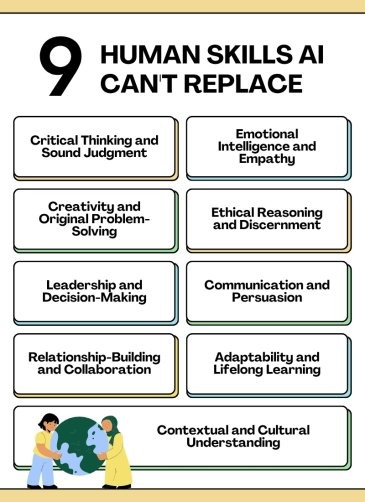
Here are nine human skills that are only becoming more valuable as AI improves:
1. Critical Thinking and Sound Judgment
AI can generate information instantly, but it can't evaluate what information actually matters, spot flawed assumptions, or weigh competing priorities the way a human can. As information becomes more abundant (and more automated), the ability to think critically about what you're reading, hearing, and being told becomes a critical professional skill.
2. Emotional Intelligence and Empathy
Emotional intelligence underpins every strong workplace relationship and culture. Leaders who demonstrate high emotional intelligence show retention rates nearly 30 points higher than those who don't, according to Korn Ferry's research on leadership trends. AI may be able to simulate a friendly tone, but it can't actually connect with someone on an emotional level (and yes, people can tell the difference).
3. Creativity and Original Problem-Solving
AI has lowered the barrier to generating ideas quickly, but volume isn't the same as originality. Humans remain the ultimate gatekeepers of which ideas are worth pursuing and why. In fact, the World Economic Forum ranks creative thinking among the top five core skills employers expect to grow in importance through 2030.
4. Ethical Reasoning and Discernment
Workday's global research on AI adoption found that ethical decision-making and moral judgment rank first among the skills leaders consider most valuable now and in an AI-driven future. Someone still has to decide what should be done with the information AI provides—and that requires a moral compass, not a model.
5. Leadership and Decision-Making
AI can accelerate change, but it can't lead people through it. When new tech reshapes how work gets done, employees still look to human leaders for clarity, direction, and reassurance.
6. Communication and Persuasion
Clearly explaining an idea, negotiating a deal, or persuading a skeptical stakeholder all require reading a room, adjusting tone, and building trust in real time—human skills, without a doubt.
7. Relationship-Building and Collaboration
AI has made it easier to work across departments, time zones, and formats, but that capability only pays off if people actually know how to collaborate well together. As cross-functional work increases, so does the value of people who can build trust and align teams around a shared goal.
8. Adaptability and Lifelong Learning
More than 40% of workers' core skills are expected to be disrupted by 2027, according to the World Economic Forum's Future of Jobs Report, putting a premium on people who can keep learning and adjusting rather than relying on a single static skill set.
9. Contextual and Cultural Understanding
AI can process enormous amounts of data, but it lacks lived experience (obviously!). Understanding a client's specific circumstances, a community's history, or a colleague's unspoken concerns requires human context.
Are Soft Skills More Important Because of AI?
Short answer: yes. The same Workday study found that 83% of business leaders agree the growing use of AI makes human skills more important, if anything, not less. The skills that leaders consistently rank as least replaceable by AI are also the ones they consider most valuable at work overall:
- Ethical decision-making
- Relationship-building
- Emotional intelligence
- Conflict resolution
This is a meaningful shift in how "soft skills" are talked about. They aren't a nice-to-have anymore; they bring a competitive edge. As routine and technical tasks become increasingly automated, professionals who stand out are those who bring judgment, creativity, and human connection to the table.
How Does a Liberal Arts Degree Teach These Skills?
A liberal arts degree teaches students how to think, question, research, write, and collaborate across disciplines. Four out of five employers say they prefer new college graduates whose education is grounded in the liberal arts, according to a study by the Association of American Colleges and Universities.
At PLNU, a liberal arts foundation means students don't just study their major in isolation—they build the ability to integrate knowledge across subjects, form original perspectives, and clearly communicate them. Whether a student is studying political science or criminal justice, pursuing a degree in social work, or preparing for a career in athletic training, the same underlying skills apply: critical thinking, ethical reasoning, and the ability to work well with people.
This kind of education also prepares students for careers that don't exist yet. As AI continues to reshape entire industries—including fields like writing in the era of AI—the students best positioned to adapt are the ones who learned how to think broadly.
How Can College Students Prepare for AI?
Prospective and current students don't need to choose between "learning AI" and "learning human skills.” After all, the strongest career paths combine both. A few reasonable starting points:
- Get comfortable using AI tools… Responsibly! Understanding how to work with AI vs. against it is quickly becoming a baseline professional skill. Start with the basics of prompt engineering.
- Choose coursework that stretches your thinking. Classes in ethics, writing, research methods, and discussion-based seminars build judgment and communication skills AI can't replicate.
- Practice explaining your reasoning, not just your answer. Whether in a classroom discussion or a group project, get in the habit of articulating why you reached a conclusion.
- Seek out collaborative and hands-on experiences. Internships, group research, and clinical or fieldwork opportunities build the relationship and communication skills that translate into the workplace.
- Stay curious about how your field is changing. AI is reshaping nearly every industry, and differently. Understanding how it's already being used in your intended career path (and where it stops short) will help you stand out.
Find Your Path at PLNU
The future of work isn't about competing with AI—it's about bringing something to the table that AI can't. Critical thinking, empathy, creativity, ethical judgment, and the ability to connect with people will only grow more valuable as automation takes on more of the routine work…
At Point Loma Nazarene University, a liberal arts education is built around developing these skills, no matter which major a student chooses. Explore PLNU's academic programs and discover how a PLNU education can prepare you not only for the jobs that exist today, but also for the ones that haven't been invented yet.
Frequently Asked Questions
Will AI take my job?
Most careers won't disappear outright, but will shift toward the human-centered parts of the work. How (and how much) AI will shift things depends on the job—or more precisely, the tasks that make up the job. AI is most likely to automate routine, repetitive, and rule-based work. Research from the U.S. Career Institute found the jobs with the lowest risk of automation are ones requiring social skills, emotional intelligence, and creativity.
Why can't AI learn soft skills?
AI can simulate the language of empathy, persuasion, or leadership, but it doesn't have lived experience, genuine emotion, or a moral compass to draw from. Soft skills like empathy and ethical judgment require real human context.
What skills should I focus on in college?
AI fluency and the human skills AI can't replicate. Practice using AI tools responsibly and prioritize coursework that builds critical thinking, communication, and ethical reasoning (think: writing-intensive classes, group discussions, research projects, and hands-on internships or fieldwork).
Does a liberal arts degree still matter in the age of AI?
Yes. A liberal arts education is built around exactly the skills research shows AI can't replace: critical thinking, communication, ethical reasoning, and the ability to connect ideas across disciplines. Four out of five employers say they prefer graduates whose education is grounded in the liberal arts.
How is AI already being used in the workplace?
Businesses use AI for tasks like screening job applicants, processing invoices and expense reports, analyzing customer data, and drafting marketing content. Nearly all executives (98%) say AI adoption delivers immediate business value, even as many employees are still adjusting to the change.