

Finishing your undergraduate degree is an exciting milestone, but deciding what your next chapter holds can be a daunting task. Maybe you are going straight into your chosen field, or taking a gap year to explore what the world has to offer. Or maybe you’ve considered whether a graduate degree is the right path for you.
PLNU offers a wide variety of graduate degrees and professional programs, from certifications to master’s and postgraduate degrees, allowing you to find the perfect program that best supports your future goals and vocation.
What is Graduate School?
Graduate school can look different for everyone, and there is no single path that must be followed. With a variety of degrees, certifications, and credentials to pursue, graduate school at PLNU can empower students to reach their highest potential.
While bachelor’s degree programs provide a well-rounded educational experience, graduate programs allow students to focus more deeply on a specific field of study. Through concentrated coursework, students can develop expertise in their chosen discipline and build a valuable network of peers and professionals.
With part-time, full-time, hybrid, or online program options, PLNU’s graduate programs are designed to work around your schedule, so you never have to choose between furthering your education and entering the workforce after graduation.
Types of Graduate Degrees
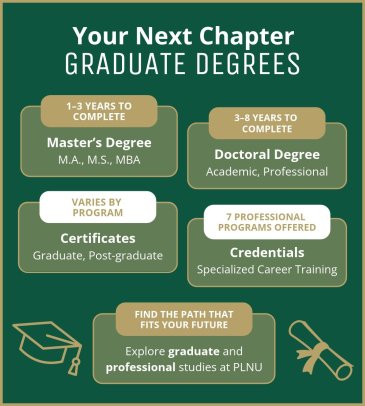
PLNU offers master's and doctoral degrees, as well as certificates and credentials, providing students with a lasting network of support. Each program is tailored to its specific field of study, equipping students with the necessary knowledge and skills to excel in their careers.
Depending on your career goals, different graduate degrees can serve different purposes and open exciting doors depending on your unique field. For careers like medicine or law, earning a professional degree is a required step toward becoming a physician or attorney, making a graduate degree necessary. However, for other fields, a masters or doctoral degree may serve as a powerful way to differentiate yourself from those who may only have a bachelor's degree. The time it takes to complete a graduate program also varies by degree and individual circumstances. At PLNU, a master's degree typically takes 1–3 years to complete, while a doctoral degree generally takes approximately 3–8 years.
Master’s degrees
Returning to school for a master’s degree could be the perfect opportunity to deepen your understanding of your chosen career or subject area after completing your undergraduate. PLNU offers a range of masters programs like Master of Arts (M.A.) or Master of Science (M.S.), as well as specialized options like an MBA.
A Masters of Business Administration (MBA) is a specialized option for students desiring to expand their knowledge of business, management, and leadership; and can include concentrations in marketing, finance, sales, or even accounting. PLNU’s early-career MBA program offers recent graduates a pathway to grow as business leaders, while our other MBA options can help experienced professionals advance their careers.
PLNU offers nearly 30 Master of Arts (M.A.) and Master of Science (M.S.) programs to prepare individuals to thrive across a variety of disciplines. M.A. and M.S. programs include kinesiology, christian ministry, occupational therapy, and school counseling, allowing students to deepen their knowledge and develop specialized skills in their chosen fields.
Doctoral degree
Sallie breaks down the two main categories of doctoral degrees, there being academic and professional doctorates. An academic doctorate mainly focuses on research and building new skills, while a professional doctorate takes these skills and applies them in real-world settings.
An academic doctorate is also known as a “Doctor of Philosophy,” which can be confusing because despite the name, a Ph.D. can apply to a range of disciplines beyond philosophy. You can receive a Ph.D. in the disciplines of humanities, sciences, or maybe you're more interested in the study of engineering and technology.
A Ph.D. and doctorate are both the highest levels of learning that you can achieve from a university. PLNU doesn’t offer any Ph.D.s, however, we have four uniquely curated professional doctoral programs to guide ambitious students and professionals to excel in the health science and nursing fields.
No matter the field, gaining a doctoral degree is no small feat. A doctoral degree requires a high level of dedication to complete the rigorous coursework and required dissertations, exams, or field-related studies. According to Coursera, doctoral degrees vary in length with a professional doctorate taking 3 to 6 years, and a PhD taking anywhere from 3 to 8 years to complete.
To learn more about the time needed to complete, units required, and program details, look at PLNU’s list of doctoral programs.
Certifications and Credentials
An undergraduate degree doesn't have to be the final stop in your education, graduate school can make it possible to do more in the field you love. Graduate certifications and credentials provide a practical way to gain additional qualifications and strengthen your professional skill set, without taking the time of a full degree program.
These programs offer a close-knit community where students receive hands-on learning, intentional mentoring, and in-depth discussion, helping students confidently apply their skills in their careers. PLNU currently offers a postgraduate certificate as a Clinical Nurse Specialist or Family Nurse Practitioner, as well as a graduate certificate in Anatomical Sciences Education.
Beyond certificates, PLNU also offers seven professional credential programs designed to prepare students for specialized roles and career opportunities. Students can pursue many of these credentials as standalone qualifications or alongside a related master's degree.
Should I go to Graduate School?
Is getting my masters or doctoral degree really more beneficial than going straight into the workforce and gaining firsthand experience? Will continuing my education after getting my undergraduate put me behind professionally? How would I be able to balance going into the workforce and getting a degree at the same time? When is the right time to go to grad school?
These are super common questions, and if you're experiencing doubt surrounding making the right choice post grad, know that you're not alone. Every student's path to success is unique, and grad school may be in the cards for individuals later down the road after they have received experience in their field, or maybe when they decide to take their career in a different direction.
That being said, here at PLNU, graduate school is not supposed to be an overwhelming decision but rather an opportunity to grow at a university that offers an education that doesn’t make you compromise. With courses offered asynchronously, in person, or virtually via Zoom, our programs don’t make you choose between keeping your day job and going to grad school.
There are many benefits to choosing to pursue a graduate degree, whether you're looking to give yourself a competitive advantage, stand out in the workplace, improve your salary, boost your networking opportunities, or simply improve your knowledge and become an expert in your chosen field. With a variety of programs from masters, doctoral, certifications, and credentials, it’s easy to find one that compliments your lifestyle and goals.
Next steps: Graduate school at PLNU
There’s no rush when deciding what next steps are right for you after receiving your degree. PLNU’s graduate programs are here to support and guide every student so that they can find a program that helps them thrive in their workplace and future career. Explore PLNU's graduate and professional studies to find out how you can take the next steps towards your future with confidence.