

Higher education isn’t just about preparing for a career: it's about deeply exploring who you are and who you’re called to be. At a Christ-centered university, the preparation extends beyond securing a first job. A faith-based education supports students to explore their vocational calling, while also developing personal and spiritual growth — all within an intentional Christian community.
Through faith integrated learning, faculty grounded in a Christ-centered mission, and a holistic approach to the college experience, students graduate not only career ready, but ready for life beyond college.
What is a faith-based education?
A faith-based education is rooted in the commitment of whole-person development — shaping students’ academic, personal, and spiritual growth. At PLNU, a university grounded in the Christian faith, students can engage in Christ-centered academics alongside intentional spiritual formation opportunities, such as:
- Chapel: Weekly, students are given the opportunity to take a break from coursework and join the university’s community in worship and reflection. The messages delivered in chapels can be anyone from on campus faculty to leaders from around the world.
- Discipleship Groups: Not only undergraduate students, but faculty and graduate students are able to participate in spiritual growth through fellowship in meaningful relationships. Undergraduate freshmen can participate in Alpha groups, while staff and all other students can find a D-Group right for them.
- Short-term missions: Students, faculty, staff and alumni can join PLNU sponsored trips around the world. These three-week long trips are meant to build upon long lasting relationships with ministries — through presence and encouragement — helping the work God is doing in the world.
- Ministry With Mexico: Throughout the school year, the PLNU community is invited to join one-day, weekend, or weeklong trips to communities in Mexico. The focus of these trips is to build and maintain foundational relationships of God’s community across the border.
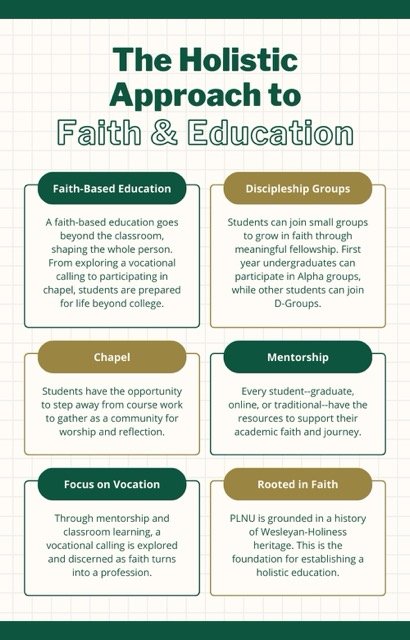
Every day, in and beyond the classroom, students explore their career field with a concern for serving others and an openness to God’s grace at work in their life. Whether studying accounting or political science, Christian ministry or mechanical engineering, Christ remains at the center of learning and future planning.
Both personal and wide-reaching discussions about faith are welcomed and fostered by Christian faculty in the classroom. Undergraduate students will be asked to take three Bible courses — Old Testament Survey, New Testament Survey, and a third class of their choosing. These classes help students understand the foundations of scripture that shape how they approach the rest of their learning, and inspire them to apply a faith-based perspective in every aspect of their life beyond college.
______
Who are you called to be?
Pursue your purpose at PLNU.
______
How does faculty support faith integrated learning?
PLNU's faith focus, alongside their 14:1 student-to-faculty ratio, helps reinforce a dynamic of genuine care and support. Professors and staff lead students by example to serve Christ with a spirit of forgiveness, trust, empathy, compassion, mindfulness, service, and gratitude in meaningful ways, such as:
- Faculty recognize God’s activity in their own vocational calling, understanding God has equipped them to be exactly where they are called to serve.
- Faculty also understand finding one’s calling takes time. Discerning a God-given calling does not happen overnight, therefore meaningful student-faculty relationships will assist in navigating this journey.1
- The integration of the Christian faith in teaching often includes a commitment to using the Bible and prayer in understanding a discipline.
- The practice of using the Bible and prayer are often avenues to open conversations about vocational calling. One example may look like talking through how students can live out the Christian faith in a specific discipline.1
- Faculty can be open to sharing their personal testimonies to share how God has shaped their own life.
At the center of their work, PLNU faculty see students not as numbers, but as people to whom they are called to educate and mentor in faith. The Christian faith boldly informs the hiring, evaluation, and professional development, which plays a crucial role in creating a cohesive environment displaying the Christian faith for our students.
“Because we're a smaller institution you also get a lot of access to your professors and you can form relationships with them. That's where the spiritual part really comes out: when we're talking one-on-one or with a small group in our offices and we can say, here's what I get out of this, here's where I see my faith coming into this, and here's how I'm living out my faith in my vocation.”
—Samuel Stoneburner, Ph.D., Assistant Professor of Chemistry
Does this still apply in STEM-related classrooms?
Absolutely. Faculty at PLNU thoughtfully engage and discuss the intersection of science and the Christian faith every step of the way. Shaped by ethics, compassion, and outreach, our approach to STEM formation prepares students to live out their calling through excellence and service. PLNU embraces this connection through opportunities such as the Science and Christian Faith, minor or a club such as the Science and Religion Club. The vision is to intellectually open these conversations to diverse beliefs to strengthen one’s faith.
“I really believe that when you study science, it's one way of studying God, because God reveals Himself to us through His creation.”
—Mike Dorrell, Ph.D., Professor of Biology
How is PLNU Rooted in Faith?
PLNU exists to provide higher education, rooted in a history of combining learning and holiness through a Wesleyan-Holiness heritage. These foundations believe the most effective form of Christian education is holistic, integrating Christian formation and Christ-like service into strong academics. This means PLNU is a community united by the Body of Christ. Staff, faculty, and administration are not merely employees but sisters and brothers in Christ and partners in ministry.
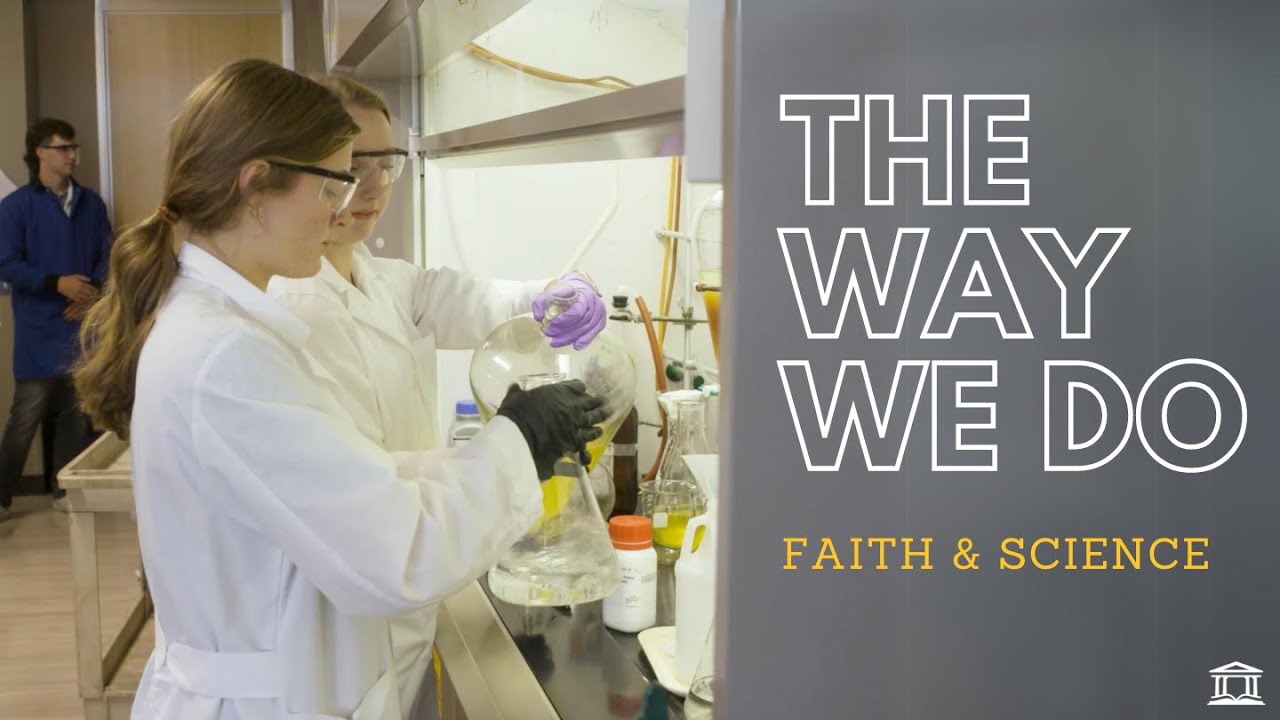
Faith and Science
Explore how PLNU engages and discusses the intersection of science and the Christian faith.
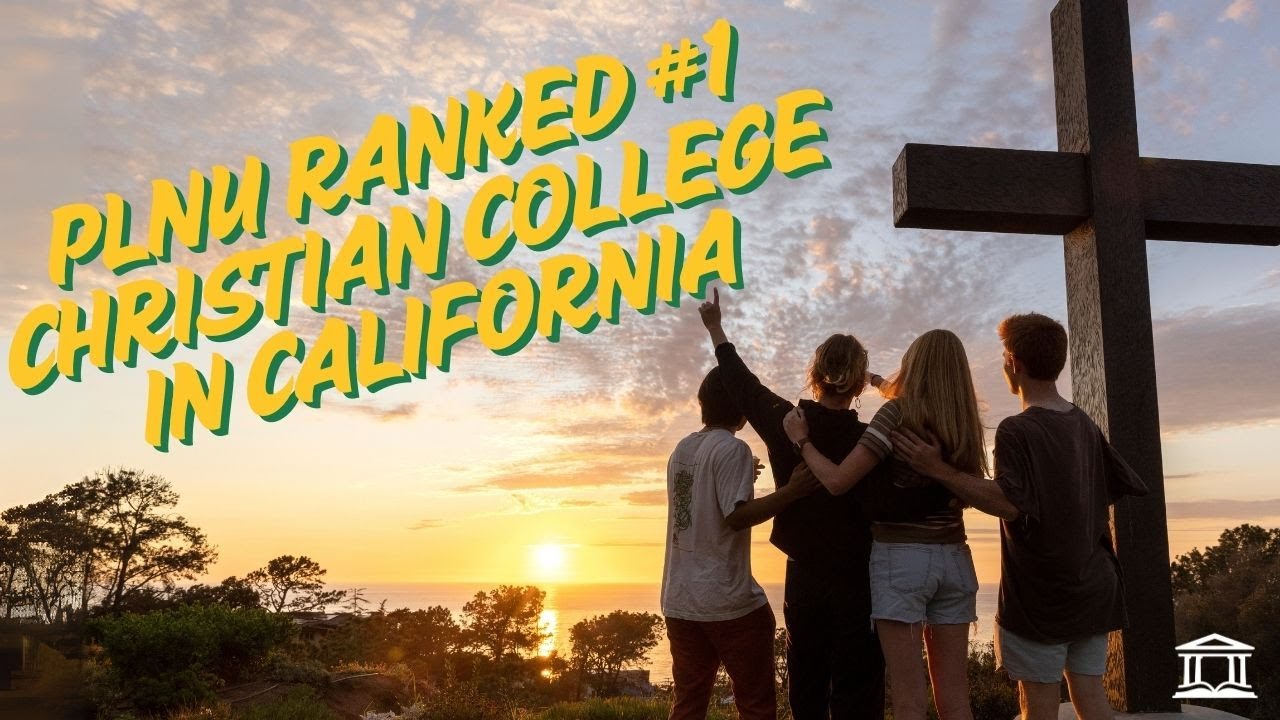
Top Ranked Christian College
Discover the ways PLNU stewards the status of consistent high rankings for Christian Colleges in California.
1Vance, R. (2023). Characteristics of Christian College Faculty Who Prioritize Students’ Development of Vocational Calling. Christian Higher Education, 22(1), 1–22. doi-org.pointloma.idm.oclc.org/10.1080/15363759.2022.2077263