
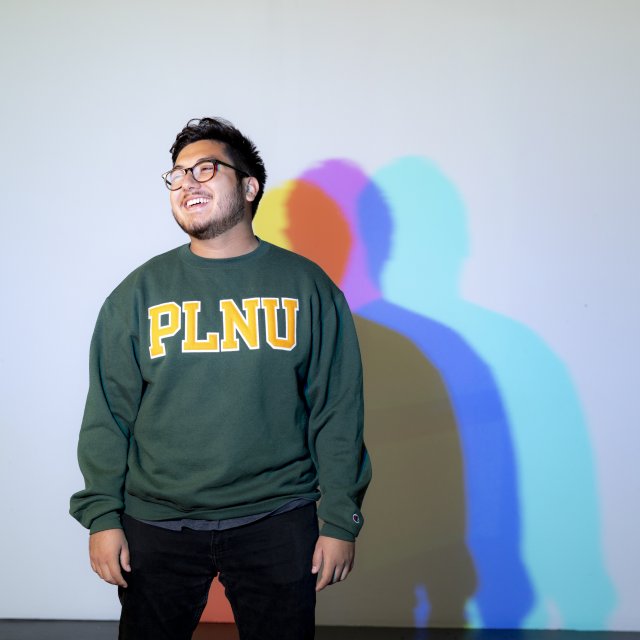
Computer software engineering alum Josue Barragan (23) didn’t have the most straight-forward college experience—especially amidst an especially challenging major, pandemic-era virtual learning, and being a first generation college student.* But through the program he found the resources, mentorship, and acceptance that left him feeling empowered.
*PLNU’s Office of Admissions defines first-generation college students as students whose parent(s) or guardian(s) do not have a bachelor’s degree.
Barragan remembers having an early fascination with computers, technology, and dissecting and optimizing systems in general. Barragan is the middle of three siblings, with a brother five years his senior who graduated from San Diego State University, and a sister four years his junior. When Barragan was about 3 years old, his mom took in her youngest brother who’s just 10 years older than Barragan.
“He’s like my older-older brother and he was the first in our family to go to college, so he was like a first-first-gen student if you can say that,” Barragan said. Barragan’s family has been “a big source of support and guidance,” he said, “always telling me to follow my dreams.”
Barragan participated in an intro to computer science class and joined his high school robotics club which helped cement his call to pursue an education and career in computer science. He graduated as one of three valedictorians from the Preuss School and was offered a nearly full-ride acceptance into UCSD established between the two schools’ coeducational partnership.
While he was accepted into the science department, however, he wasn’t offered acceptance into the computer science major itself.
“I really knew that's what I wanted to do,” he said. “That’s my passion.”
Fortunately, during the college application process, Barragan’s academic advisor recommended applying to a wide range of top STEM schools including UCLA, UC Berkeley, and Stanford. And, in the process, Barragan discovered the concept of Christian liberal arts schools and was immediately drawn to PLNU.
“I was like, ‘No way! That’s an actual thing? Like-minded people going to study something cool like computer science, which I love, but who have the same mindset of praising God?’ And it was just so enticing,” he said. As the acceptance deadline approached, Barragan found himself struggling to decide between UCSD and PLNU.
“I didn't know what I was going to do,” Barragan said. “I basically just prayed and looked for guidance and applied for a bunch of scholarships and told my parents, ‘this is what I want to do,’ and essentially just took the leap of faith. And by the grace of God, I was able to get a bunch of scholarships and financial aid that makes it almost a full ride.”
Through his academic achievement and socioeconomic status, Barragan was able to qualify for the Cal and Pell Grants, as well as academic and need-based scholarships through PLNU. He later received additional PLNU departmental and named scholarships along with multiple awards from local foundations and his father’s employer, the National Steel and Shipbuilding Company (NASSCO) branch of General Dynamics based in San Diego Harbor, where he serves as a leader in the welding maintenance department building commercial cargo and Navy auxiliary ships.
During the fall 2020 semester, while in virtual instruction, Barragan began working as a teaching assistant (TA) within the Department of Mathematics, Information & Computer Sciences (MICS) with computer science professor Lori Carter, Ph.D., as well as others who each continued to recommend Barragan. The following summer of 2021, as PLNU began returning to in-person instruction, Barragan participated in PLNU’s summer research program, mentored by adjunct professor Darren Bennett, who also serves as chief information security officer for the City of San Diego, as well as Maria Zack, Ph.D., chair of the MICS department.
“Because San Diego’s a big city that mostly has small businesses, many of these businesses can't afford all that is needed to build their cyber security infrastructure,” Zack said. Barragan’s role in the research project included helping create a free cyber range for computer professionals to learn to better detect and respond to threats.
“Because many of the most common tools used in intrusion detection, prevention, and forensics are actually free as open-source,” Zack continued, “the question is how do we build an environment and learning tool that's free for different people in the city, in the region, and in higher education, but also for businesses that want to have their people have an opportunity to get some training?”
In addition to the valuable connections with professors. Barragan made many connections on campus thanks to his openness to people from all walks of life.
“Point Loma revolves so much around residential life,” he said, “but you keep learning, you keep growing, and you try to get out there and find friendships. That's how I found my way, being able to socialize and find friends within my department or general ed classes.
“Growing up in [the Preuss] school, as they prepared us for college, I’d already mentalized those things, like, ‘You're going to look so different than all your classmates; they're going to be from different backgrounds socially, economically, culturally, and everything.’ And one thing I will always remember from my math teacher who was also like a life coach and was always telling us, ‘Whenever you feel imposter syndrome or that you don’t belong, just remember that you have a place there and that you were accepted for a reason.’”
Barragan explained that in spite of the challenges of learning during the COVID-19 pandemic, it helped him gain a posture of thankfulness.
“The pandemic actually empowered me more, I believe, which is weird, right? You’d expect the opposite,” he said. “But I realized what I was missing out on, you know? So when I came back to Loma in person, I came with a mindset of making these last years the best of my college life. Like I'm going to make connections, I'm going to help other students as a TA and do study sessions and a bunch of activities.”
The support he received as a first-generation student also inspired him to want to give back to future students who may also lack access to education.
“I’ve just developed this sense of gratitude, you know? Like I might have it a little bit harder than other people, but being able to come to Point Loma for me was already a win,” he said. “I’ve become a big advocate for education and being able to grow and see different perspectives. I hope to be able to be that light to later generations when I become a professional, to be able to explain and show the importance of education. And I really want to get to the point where I can help others because I've been helped so much. I'm here because of that help. And I want to be able to be that stepping stone for other people too.”