
Are you someone who enjoys being outdoors, talking with and helping people, or simply doesn’t want to spend all day behind a computer? There are a variety of careers that can allow you to spend more time in the field than at a desk. Below, explore 10 different jobs that can take you around the region (or world) where you work or simply keep you on the move during your shift.
Highlights
- Most non-desk jobs cannot guarantee you’ll never sit behind a desk; almost all jobs still require at least some administrative work.
- Non-desk jobs can come in a variety of forms — anything from being a healthcare professional, where your work is highly hands-on, to being a social media manager, where your main role may involve capturing content in the field.
- Working a non-desk job can lead to a variety of skills that may be harder to learn in a more traditional work environment. In the field, you can face unexpected hurdles, diverse environments and people, and opportunities to learn specialized tasks — giving you a unique advantage to add to your skillset.
Environmental Engineer
Median Salary: $117,110 | Job Growth: 6% (2025–35) | Number of Jobs: 39,100
A person who is driven to solve problems, specifically involving environmental solutions, and seeks to apply mathematical knowledge to real-world skills may be best suited to be an environmental engineer. While you’ll likely spend time at a desk planning, creating, and managing systems and equipment, environmental engineers will spend intentional time outdoors researching and monitoring equipment. Environmental engineers can work in a variety of sectors such as water management, waste management, or pollution damage by designing improvements, advising corporations, monitoring progress, or analyzing data.
The path to becoming an environmental engineer may be easier than it sounds. Employers in this field often look for an engineering degree that is environmental engineering or a related discipline, along with experience or a concentration in environmental work. For example, a student looking to major in general engineering or mechanical engineering and planning to do an internship for a water supply company would have a great opportunity for a career as an environmental engineer.
Explore 9 other engineering jobs you can pursue with an engineering degree.
Psychologist/Counselor
Median Salary: $99,110 | Job Growth: 6% (2025–35) | Number of Jobs: 209,400
When you picture a counselor or therapist, you are probably not thinking of someone sitting behind a computer. This can be a meaningful career for someone looking to help the mental health needs by listening, building relationships, and working together to find solutions. While many therapists still have a desk or continue their work using telehealth, they will spend the rest of their time traveling and working with patients to meet their mental health needs.
To become a counselor or therapist, there are a variety of pathways to take depending on your career goals.
- Undergraduate education may begin with a degree in psychology or a related field, with plans to enter a graduate program afterward.
- With an M.A. in Clinical Counseling, you can opt to become a Licensed Marriage and Family Therapist (LMFT) or a Licensed Professional Clinical Counselor (LPCC). Should you study to become an LMFT or LPCC therapist? This will depend on your interests, and a master’s program will prepare you for both.
- Another option to consider is earning your Doctor of Psychology in Clinical Psychology (PsyD), where you will work in health services integrating psychotherapy, clinical decision-making, research interpretation, and diagnosis in mental health care.
Registered Nurse
Median Salary: $97,550 | Job Growth: 6% (2025–35) | Number of Jobs: 3,465,400
As a career where you get to meet people during some of their most vulnerable and joyful moments, nursing allows you to constantly be on the move. From helping patients to documenting care, you will likely spend more time on the move and interaction with others than at a desk. Among opportunities for social interaction, staying active, and making a meaningful difference in people’s lives, nursing may be the right career for you.
To become a nurse, there are a variety of pathways you could take depending on your previous education and career goals.
- Get a Bachelor's of Science in Nursing (BSN) from an accredited four-year university.
- Another pathway is to earn an associate degree in nursing (ADN) or a diploma in practical nursing, then pass the NCLEX-PN to become a registered nurse (RN). You can then further your education by getting your BSN later on through an accelerated program.
Exercise/Performance Physiologist
Median Salary: $59,460 | Job Growth: 13% (2025–35) | Number of Jobs: 21,200
For people interested in health, movement, and working directly with clients, a physiologyist can offer opportunities to stay active and in motion. A performance physiologist will work with clients ranging from professional athletes to general patients focusing on a specific health goal, whether that be in sports, fitness, or in rehabilitation. The goal of a physical therapist will be to understand a patient’s needs, diagnose the issue, and develop a plan to get the client to the desired outcome through techniques and exercises of movement, stretching, endurance and strength.
To work as a licensed physiologist, you’ll first want to get a bachelor’s degree in exercise physiology, exercise science, kinesiology, health science, or a related field. A great program to set you up for success is the Health Science, B.S., which equips you with foundational knowledge, networking opportunities, and hands-on experience in clinics.
To further your education and expertise, you can explore master’s programs focusing on clinical work with performance or sport related care. A Kinesiology, M.S. program can equip you with in-depth skills and practical experience aligned with your concentration and career goals.
Teacher
Median Salary: $72,040 | Job Growth: 0% (2025–35) | Number of Jobs: 1,087,500
While there are many desks within a classroom, ranging from preschool to the college level, a teacher isn’t always sitting behind one. Through planning lessons, communicating ideas and instruction, and creating a space for growth and development, teachers work with students to build foundational knowledge and skills for future grades, classes, jobs, and careers.
The pathway to become a teacher depends on the concentration and desired age range you hope to teach.
- Preschool teachers will be required at the minimum to have an associates degree, although most public schools across the United States are starting to require a bachelor’s degree.
- Elementary and middle school teachers are required to have at least a bachelor's degree. Certain states require high school teachers to have a specific major within the field of the desired subject to teach, such as English or mathematics.
- For all teachers, it is required to be licensed or certified for the grade they will teach. This often involves a student-teaching program, a background check, and a general certification test.
- It may be beneficial to look into graduate school programs for credentials and certifications. Depending on the credential that is right for you, they may help improve teaching skills and empower certain student groups you are passionate about.
__________
Who are you called to be?
Pursue your purpose at PLNU.
__________
Wildlife/Conservation Biologist
Median Salary: $73,920 | Job Growth: 4% (2025–35) | Number of Jobs: 40,900
Just as it sounds, conservationists spend significant time and effort outdoors managing land, parks, wildlife, or natural resources. Depending on the area of focus, conservation biologists will assess the quality of land or wildlife by testing soil, air and water quality, or natural disaster possibilities. A person in a position like this would still use the tools of a computer, but this would likely relate to analyzing and collecting data to better understand the natural environment.
To pursue a career in this field, such as a conservation biologist, forester, or wildlife biologist, a bachelor's degree in the related field is typically required. A degree, such as the Environmental Sciences, B.S., can help prepare you to understand and address pressing environmental problems around the world.
Producers and Directors
Median Salary: $90,360 | Job Growth: 4% (2025–35) | Number of Jobs: 181,000
Producers and directors in film often never find themselves in one space, as they are always on the move between film shoots, making business decisions about the productions, and overseeing the translation from script to screen.
- Producers can have a variety of roles, from managing personnel, dealing with finances, and to working on the overall timeline of the project.
- Directors typically focus on the production’s creative direction, making decisions and managing the cast, locations, designers, and audio teams to create a final piece.
Typically, becoming a producer or director requires a bachelor's degree and years of experience in the industry. Graduates from different universities have studied communications degrees, and often will have an advantage doing a program concentrating in media. A program to consider is a Media Communications, B.A. with a concentration in film. In this program, you have the opportunity to attend popular events like Sundance Film Festival, as well as participate in internships that provide real-world experience.
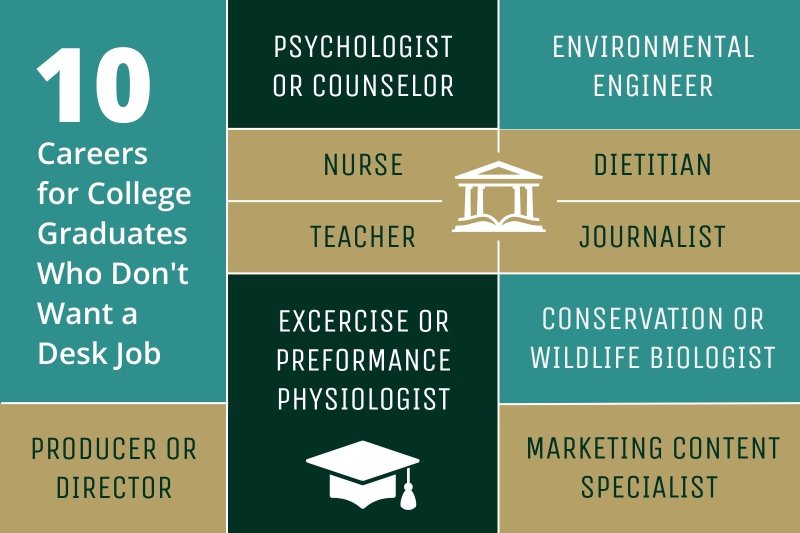
Dietitian
Median Salary: $76,400 | Job Growth: 8% (2025–35) | Number of Jobs: 86,300
A dietitian works with clients to assess nutritional needs, develop a plan to help solve issues, and monitor results during the progress. A dietitian spends a fair amount of time at a desk charting results, patient history, and developing plans, but the other majority of the time in this role is spent with patients, especially within a clinic.
The pathway to become a dietitian will usually require a bachelor's degree. There are certain certifications or licensures that may require a master’s degree. A Dietetics, B.S. is a great program to set you up for success.
Journalist
Median Salary: $62,200 | Job Growth: -6% (2025–35) | Number of Jobs: 47,100
While journalists are often sitting down to write articles or content, they are just as often in the field researching, interviewing, and observing people, places, and events. Journalists may be traveling locally, regionally, or even internationally to capture in-depth stories relating to topics they're passionate about. Another option for journalists is to work independently and contribute freelance work to different organizations.
The barrier to entry as a journalist is surprisingly minimal. When working for an organization, you’ll typically be required to have a bachelor’s degree in journalism or multimedia journalism. If you want to write on the side or freelance, it can be as simple as just writing things you are passionate about with a pen and paper! You’ll want to build up a strong portfolio to get clients, which is where a program like Multimedia Journalism, B.A. will help build a resume, portfolio, and experience to give you an upper edge.
Marketing Content Specialist
Median Salary: $74,750 | Job Growth: 2% (2025–35) | Number of Jobs: 314,500
As a specialist in the marketing field, you can work a wide range of roles from content creation, capturing people, places, and events, to public relations to externally represent your organizations. This job will likely involve some time behind a computer, but it’s a job where you can be on the move capturing the essence of your brand and then turning it around to share with the public.
The path to a role in a marketing position is best reached with a bachelor's degree. A great pathway option could be programs like Marketing, B.S., Communications, B.A., or Multimedia Journalism, B.A..
Begin Your Journey at PLNU
The idea of working a job beyond a desk environment does not have to be out of reach — it's about choosing the right path that fits your goals. Whether you want to explore a career in the medical field or journalism, It's important to think about working towards a degree that equips you with the skills such as critical thinking, empathy, creativity, ethical judgment, and the ability to connect with people.
At Point Loma Nazarene University, a liberal arts education is built around developing these skills, no matter which major a student chooses. Explore PLNU's academic programs and discover how a PLNU education can prepare you not only for the traditional jobs, but for the jobs that can take you around the world.